

Product
One record. From the teardown to the shipping label.
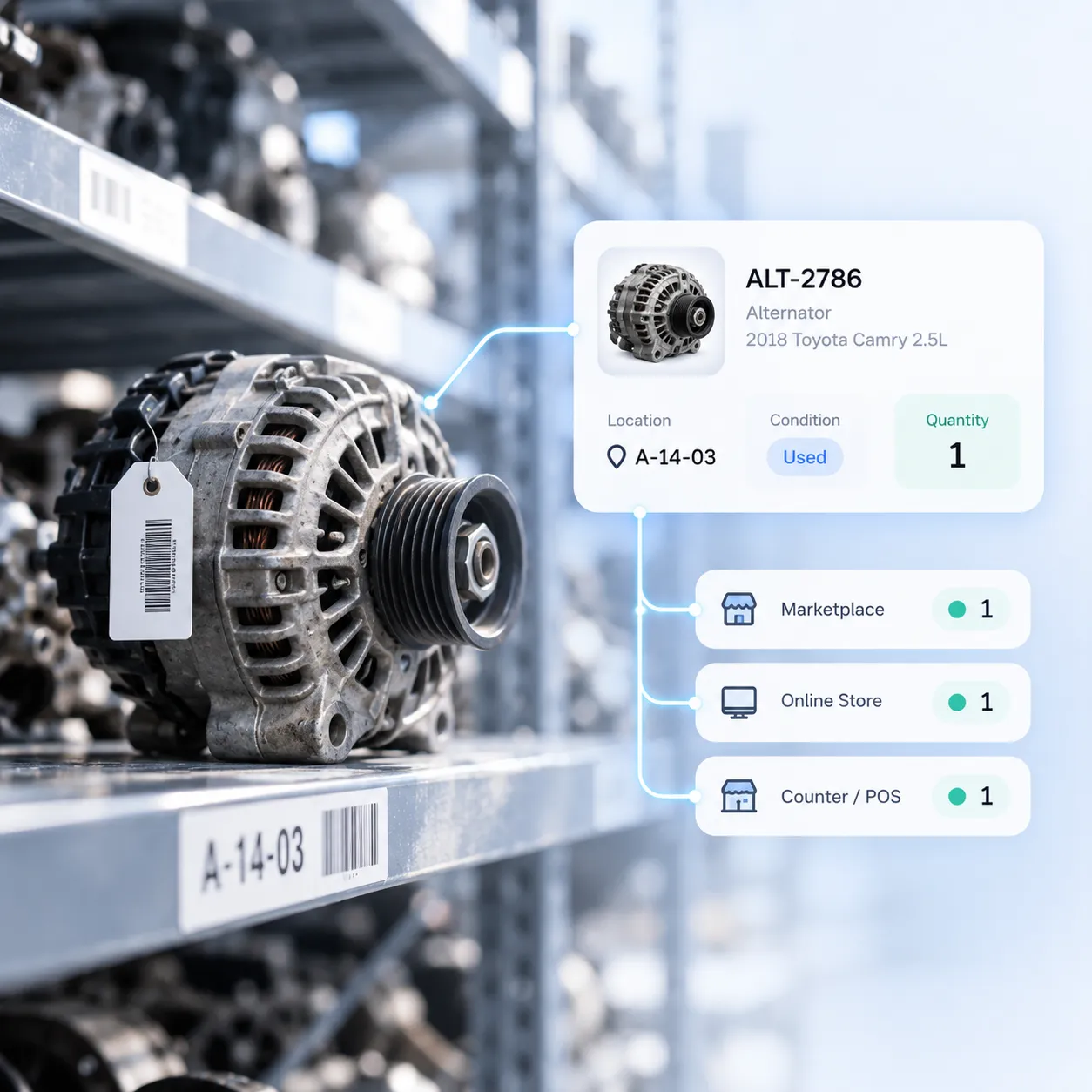
Catalogued, located, listed on every channel, priced from your own sales — and ended everywhere the moment it sells.
- Fitment inherited from the donor VIN
- Nothing publishes without a person
- Sold once, ended everywhere
The pipeline
A part is listed once. Told everywhere. Ended everywhere.
- 01
The donor arrives
One VIN is decoded once. Year, make, model, engine: every part pulled from that vehicle inherits its fitment. Nobody retypes a donor.
- 02
The agent drafts
Title, category, condition, photos in order, and a price argued from your own sales history. Drafted while the part is still on the shelf. Not published.
- 03
You approve
Nothing publishes itself. A person reads the draft, edits what the agent got wrong, and presses approve. This screen cannot be bypassed.
- 04
Live everywhere
One approval publishes to every connected channel. eBay and your storefront each get their own dialect of the same record.
- 05
It sells once
On any channel. A used part has quantity one, so the first sale is the only sale.
- 06
It ends everywhere
The sale on one channel ends the listing on every other, immediately and without anyone remembering to. This is the entire point.
- 07
It goes on the record
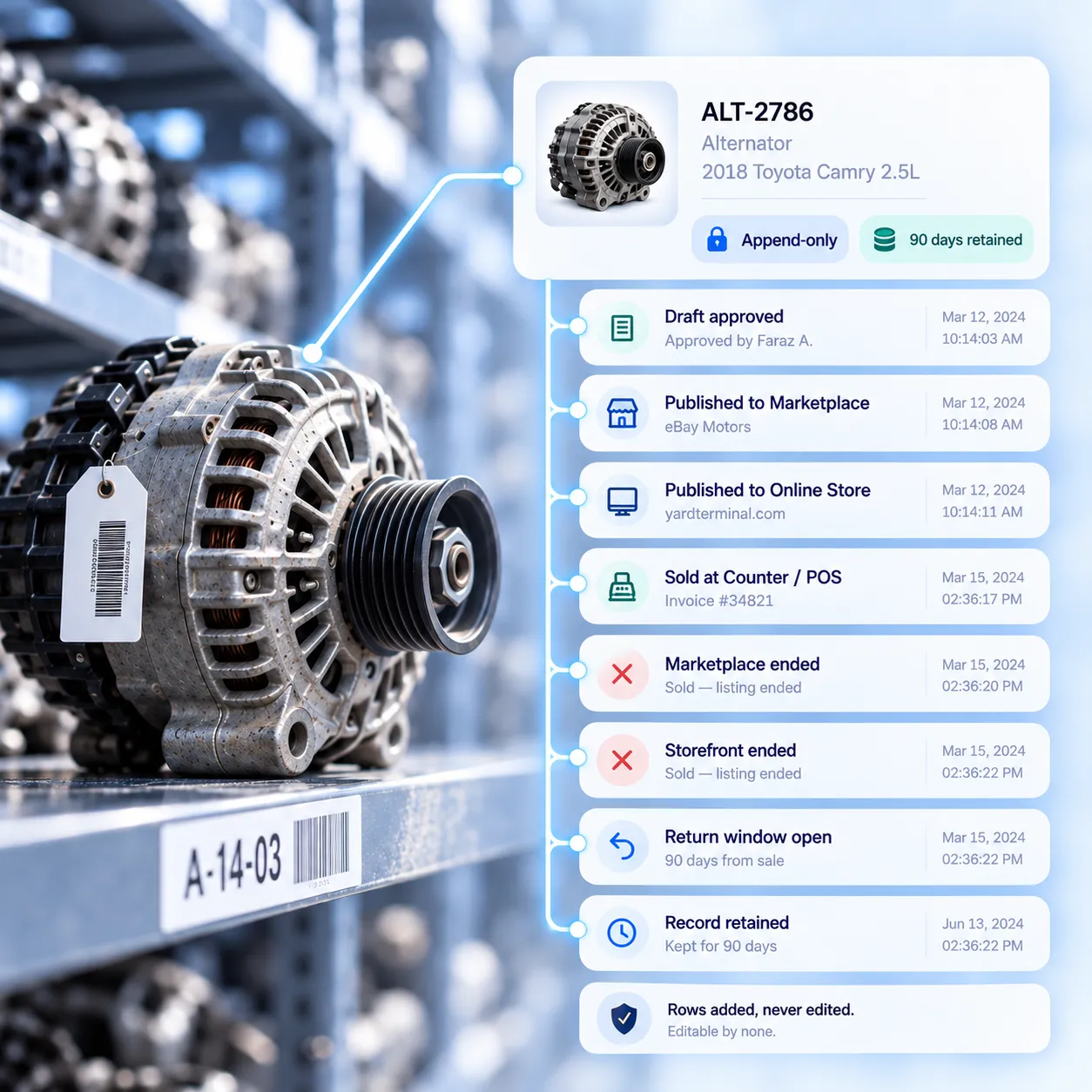
Who approved it, where it sold, when each channel ended: appended to a trail nobody can edit. Kept through the return window.
The fitment
The hard question is not what car it came off. It is what else it fits.
The donor VIN answers the first question for free and answers it perfectly. The second one — which other vehicles take this identical part — is the question Hollander sells, and it is the one that decides whether a buyer filtering by their car ever sees your listing at all.
- 01
Seeded from the donor
Year, make, model and engine, decoded once from seventeen characters. Free, and correct by construction — this part came off that car.
- 02
Extended from the catalog
Where eBay's own catalog already knows a part number, its fitment comes back with it. Where the number is stamped on the casting and readable, we read it.
- 03
Proposed, and labelled as proposed
The agent suggests the wider list and marks every entry as verified or suggested. It does not quietly present a guess as a fact, because a wrong fitment costs you the part, the sale and the freight both ways.
- 04
Confirmed by you — and then it is yours
You approve the list before it publishes. Every confirmation feeds your own catalogue, so the next one of these arrives already filled in. You are building a reference, not renting one.
The agent
Photos and a VIN become a listing. You still press approve.
01
It reads the donor, not a form.
Photos from the bay, VIN already decoded. Year, make, model, engine: inherited. The agent never asks you to retype a vehicle you already entered.
The cascade
Sold once. Ended everywhere.
The moment a sale lands on any channel, every other listing for that part is ended and verified, not assumed. The alternative is a cancellation — and a cancellation is a defect on your account, whatever the reason. Two in a hundred orders and eBay stops showing your listings.
- 14:32:07.114eBay MotorsSold
- 14:32:07.140StorefrontEnded
- 14:32:07.152Counter POSRemoved
- 14:32:07.166InventoryQty 1 → 0
Illustration. The order is the guarantee, not the timings.
One record owns the count. Every channel reads it. None keep a copy.
The guarantees
What the record promises. Four properties the system enforces so nobody at the yard has to remember to.
01
One record owns the count.
There is no second number to disagree with the first.
The oversell bug is always two systems both believing they hold the quantity. Here channels hold listings, never stock. Every count question has exactly one answer.


What ships. Nine facts. Nothing promised that is not in the product.
VIN once. Fitment everywhere.
Decode the donor once. Every part pulled from that vehicle inherits year, make, model, engine.
Draft · not published
AI drafts the listing.
Title, photos, condition, and a price from your own sales. Never published on its own.
ApproveCannot be turned off
You still press approve.
The gate cannot be turned off. A person reads the draft first.
- eBay Motors
- Shopify storefront
eBay and Shopify.
One record, two dialects. Adding a channel never adds a second count.
14:32:07 · ended everywhere
Sold once. Ended everywhere.
The first sale ends every other listing. Verified, not assumed.
append-only
Kept on the record.
Who approved, where it sold, when it ended. Append-only through the return window.
Fast from the second one.
Catalogue a part once. The next identical part off any car matches on its part numbers and arrives filled in, and so does every one after.
Where the part is.
Hall, aisle, rack, shelf, bin — recorded on teardown, not remembered.
Tied to the car.
What you paid for the vehicle, every part pulled from it, every sale and its channel.
Built for parts that come off a car, not out of a box.
Generic inventory software treats quantity one as an edge case. Here it is the default.
1
Quantity
One, by default. Not a special case to configure.
- Donor vehicle
- The parent record. Parts inherit fitment from it.
- Interchange
- A first-class field, not a note in the description.
- Condition & grade
- Structured fields, so buyers filter on them.
- Core charges
- Priced and tracked, not typed into the title.
- Ended listings
- Kept 90 days - covers eBay returns and most payment disputes, so a dispute has a record.
- Photos
- Shot once, sized per channel automatically.
- Multi-yard
- Separate inventory, separate staff, one login.